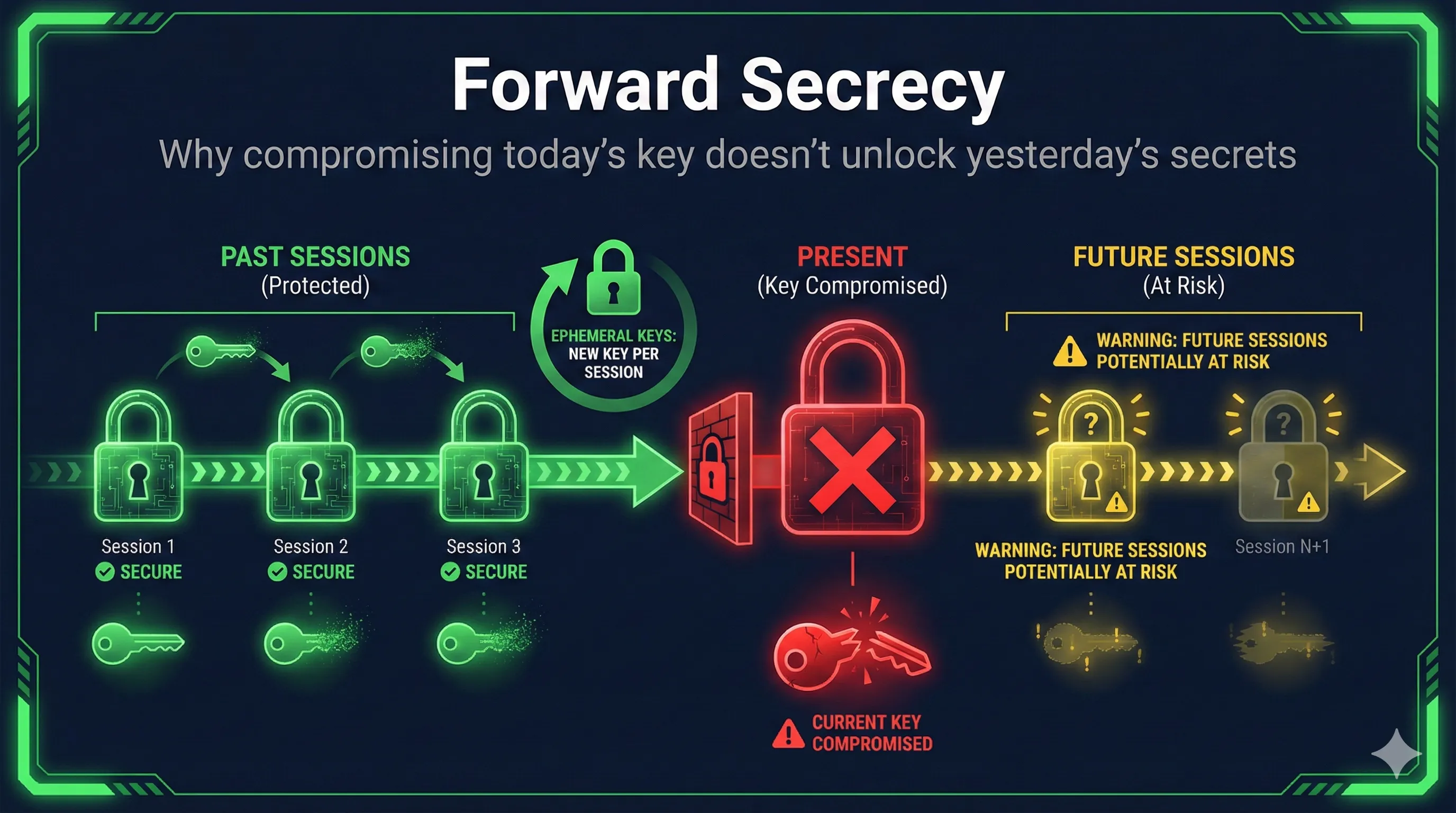
Quick Answer: What is Forward Secrecy?
Forward Secrecy (also called Perfect Forward Secrecy or PFS) means that your encrypted communications stay secret even if your private key is stolen in the future.
Without Forward Secrecy
Attacker records encrypted traffic → Later steals private key → Decrypts ALL past communications
With Forward Secrecy
Attacker records encrypted traffic → Later steals private key → Past communications remain encrypted!
The key insight: Each session uses unique, temporary keys that are deleted immediately after use. Even with the server's private key, those session keys cannot be recovered.
The Problem: Stolen Keys
Without vs With Forward Secrecy
Without Forward Secrecy (RSA)
With Forward Secrecy (ECDHE)
Imagine a sophisticated attacker (nation-state, criminal organization) who:
- 1. Records all encrypted traffic passing through their network tap
- 2. Stores this data indefinitely (storage is cheap)
- 3. Years later, obtains your private key through:
- • Server breach or hack
- • Legal compulsion (subpoena)
- • Insider threat
- • Cryptographic advances
- 4. Decrypts years of past communications!
Real-World Examples
- NSA's "collect it all" approach: Record everything now, decrypt when keys become available
- Heartbleed (2014): Bug allowed extraction of private keys from memory
- Quantum computing threat: Future quantum computers may break current RSA keys
Without forward secrecy, this "harvest now, decrypt later" attack is completely viable. Your data from 2020 could be decrypted in 2030.
RSA Key Exchange Vulnerability
In traditional RSA key exchange (used in older TLS configurations), the client creates a secret and encrypts it with the server's public key.
How RSA Key Exchange Works
- 1. Server has a long-term RSA key pair (same for years)
- 2. Client generates a random "pre-master secret" (PMS)
- 3. Client encrypts PMS with server's public key
- 4. Server decrypts PMS with its private key
- 5. Both derive session keys from PMS
The Fatal Flaw
The encrypted PMS is sent over the network and can be recorded.
- • If attacker later obtains the private key...
- • They can decrypt the recorded encrypted PMS
- • From PMS, they derive the session keys
- • With session keys, they decrypt ALL session data
# Captured traffic contains:
ClientHello
ServerHello, Certificate (contains public key)
ClientKeyExchange: RSA_Encrypt(PMS, public_key)  # Attacker records this
                                                  # ↑ This is the problem!

# Later, with stolen private key:
PMS = RSA_Decrypt(recorded_ClientKeyExchange, private_key)
session_keys = PRF(PMS, random_values)
plaintext = Decrypt(recorded_traffic, session_keys)  # Game over
How Ephemeral Keys Work
How Ephemeral Keys Work
Forward secrecy uses ephemeral (temporary) keys for each session. The key insight: both parties contribute randomness, and the shared secret is never transmitted.
ECDHE Key Exchange Process
- 1. Both sides generate ephemeral key pairsClientprivate: a, public: A = aGServerprivate: b, public: B = bG
- 2. Exchange public ephemeral keys
Client sends A, Server sends B (both visible to attacker)
- 3. Each computes the same shared secretClient: a × B = a × bG = abGServer: b × A = b × aG = abG
- 4. IMMEDIATELY DELETE ephemeral private keys (a and b)
Keys exist only in memory for milliseconds
Why This Protects Past Traffic
- Attacker sees A and B (public keys) but NOT a and b (private keys)
- Computing abG from aG and bG is the Discrete Logarithm Problem (computationally infeasible)
- Server's long-term private key is NOT used to derive the shared secret
- Ephemeral keys are deleted, so can never be recovered
The Power of Deletion
The ephemeral private keys (a and b) exist only in RAM for a fraction of a second. Once deleted, they cannot be recovered even with physical access to the server. Without them, the shared secret cannot be reconstructed.
ECDHE vs RSA: Key Comparison
ECDHE vs RSA Key Exchange
| Aspect | ECDHE | RSA |
|---|---|---|
| Key Type | Ephemeral (per session) | Static (long-term) |
| Forward Secrecy | ✓ Yes | ✗ No |
| Key in Memory | Seconds | Months/Years |
| Past Traffic Risk | Protected | Exposed if key stolen |
| Performance | Fast (ECC math) | Slower (large keys) |
| TLS 1.3 Support | Required | Not allowed |
Always prefer ECDHE cipher suites — they're faster AND more secure
| Aspect | RSA Key Exchange | ECDHE Key Exchange |
|---|---|---|
| Forward Secrecy | No | Yes |
| Key Lifetime | Years (certificate validity) | Milliseconds (session only) |
| Secret Transport | Encrypted, sent over network | Computed locally, never sent |
| Past Traffic Risk | Decryptable if key stolen | Safe even if key stolen |
| TLS 1.3 Support | Removed | Required |
| Performance | Faster (no DH computation) | Slightly slower but negligible |
Key Exchange Methods Ranked
The "E" is Everything!
The "E" in ECDHE and DHE stands for Ephemeral. This single letter is the difference between forward secrecy and vulnerability. ECDH and DH without the E use static keys that provide no forward secrecy.
The Math Behind It
Forward secrecy relies on the Discrete Logarithm Problem: given A = aG, it's computationally infeasible to find a.
Elliptic Curve Diffie-Hellman
Setup: Both parties agree on an elliptic curve and generator point G
Client generates: random a, computes A = a × G (point multiplication)
Server generates: random b, computes B = b × G
Exchange: Client sends A, Server sends B
Shared secret:
Server computes: b × A = b × (aG) = abG
Both get the same point abG!
Why Can't Attackers Compute It?
Attacker knows: G, A = aG, B = bG
Attacker needs: abG
To get abG, they would need to know either a or b
Finding a from A = aG is the Elliptic Curve Discrete Logarithm Problem (ECDLP). With a 256-bit curve (P-256), this would take longer than the age of the universe with current technology.
Popular Curves for ECDHE
- P-256 (secp256r1) - NIST standard, widely supported
- P-384 (secp384r1) - Higher security level
- X25519 - Modern, fast, resistant to timing attacks (TLS 1.3 default)
Testing Forward Secrecy
Using OpenSSL
# Check what cipher suites a server supports
openssl s_client -connect example.com:443 2>/dev/null | grep -E "(Cipher|Protocol)"

# Look for ECDHE or DHE in the cipher name
# GOOD: TLS_ECDHE_RSA_WITH_AES_256_GCM_SHA384
# BAD:  TLS_RSA_WITH_AES_256_GCM_SHA384

# Test specific cipher
openssl s_client -connect example.com:443 -cipher ECDHE-RSA-AES256-GCM-SHA384

# List all supported ECDHE ciphers
openssl ciphers -v 'ECDHE' | head -20
Using nmap
# Enumerate all cipher suites
nmap --script ssl-enum-ciphers -p 443 example.com

# Look for cipher suites with ECDHE or DHE prefix
# These provide forward secrecy
Online Tools
- • SSL Labs: ssllabs.com/ssltest - Shows "Forward Secrecy" rating
- • testssl.sh: Comprehensive TLS testing with FS analysis
- • Hardenize: Shows which cipher suites provide forward secrecy
Enabling Forward Secrecy
nginx Configuration
# Modern TLS configuration with forward secrecy
ssl_protocols TLSv1.2 TLSv1.3;

# Prefer ECDHE cipher suites (forward secrecy)
ssl_ciphers 'ECDHE-ECDSA-AES256-GCM-SHA384:ECDHE-RSA-AES256-GCM-SHA384:ECDHE-ECDSA-CHACHA20-POLY1305:ECDHE-RSA-CHACHA20-POLY1305';

# Use server's preferred cipher order
ssl_prefer_server_ciphers on;

# Enable ECDHE with modern curves
ssl_ecdh_curve X25519:secp384r1:secp256r1;

# Generate strong DHE parameters (if using DHE)
# openssl dhparam -out /etc/nginx/dhparam.pem 2048
ssl_dhparam /etc/nginx/dhparam.pem;
Apache Configuration
# Enable modern protocols
SSLProtocol -all +TLSv1.2 +TLSv1.3

# Prefer ECDHE cipher suites
SSLCipherSuite ECDHE-ECDSA-AES256-GCM-SHA384:ECDHE-RSA-AES256-GCM-SHA384:ECDHE-ECDSA-CHACHA20-POLY1305:ECDHE-RSA-CHACHA20-POLY1305

# Use server's preferred cipher order
SSLHonorCipherOrder on

# Strong DHE parameters
SSLOpenSSLConfCmd DHParameters "/etc/apache2/dhparam.pem"
The Easiest Solution: TLS 1.3
TLS 1.3 requires forward secrecy by design. All TLS 1.3 cipher suites use ECDHE. If you enable TLS 1.3, you automatically get forward secrecy.
Related Resources
Key Exchange
Deep dive into Diffie-Hellman and ECDHE algorithms.
How TLS Works
See how forward secrecy fits into the TLS handshake.
Cipher Suite Decoder
Identify which cipher suites provide forward secrecy.
TLS Version Comparison
Why TLS 1.3 requires forward secrecy by design.
Encryption Basics
Understand the cryptographic foundations of key exchange.
TLS Handshake
Where ephemeral key exchange happens in the protocol.
Encrypted Client Hello (ECH)
ECH uses the same key exchange principles to encrypt the ClientHello itself.
Frequently Asked Questions
Is forward secrecy the same as perfect forward secrecy (PFS)?
Yes, they're the same thing. "Perfect Forward Secrecy" was the original term, but "Forward Secrecy" is now preferred because the "perfect" was considered misleading (nothing is perfect in security).
Does forward secrecy slow down my server?
Negligibly. ECDHE adds about 15% to the handshake computation compared to RSA key exchange, but modern CPUs handle this easily. The security benefit far outweighs the tiny performance cost.
What if I use a CDN?
Major CDNs (Cloudflare, AWS CloudFront, Fastly) enable forward secrecy by default. The TLS connection terminates at the CDN edge, so they control the cipher suites. Check your CDN's security settings.
Does forward secrecy protect against quantum computers?
Current ECDHE is vulnerable to quantum attacks (Shor's algorithm). However, post-quantum key exchange algorithms are being developed. The key principle of ephemeral keys will still apply - just with different math.
Why is RSA key exchange still used anywhere?
Legacy compatibility. Some very old clients don't support ECDHE. However, TLS 1.3 completely removed RSA key exchange, so it's being phased out. New deployments should always use ECDHE.
Continue Learning
Watch the interactive demo to see forward secrecy in action, with step-by-step visualization of RSA vs ECDHE key exchange.
Try the Interactive Demo