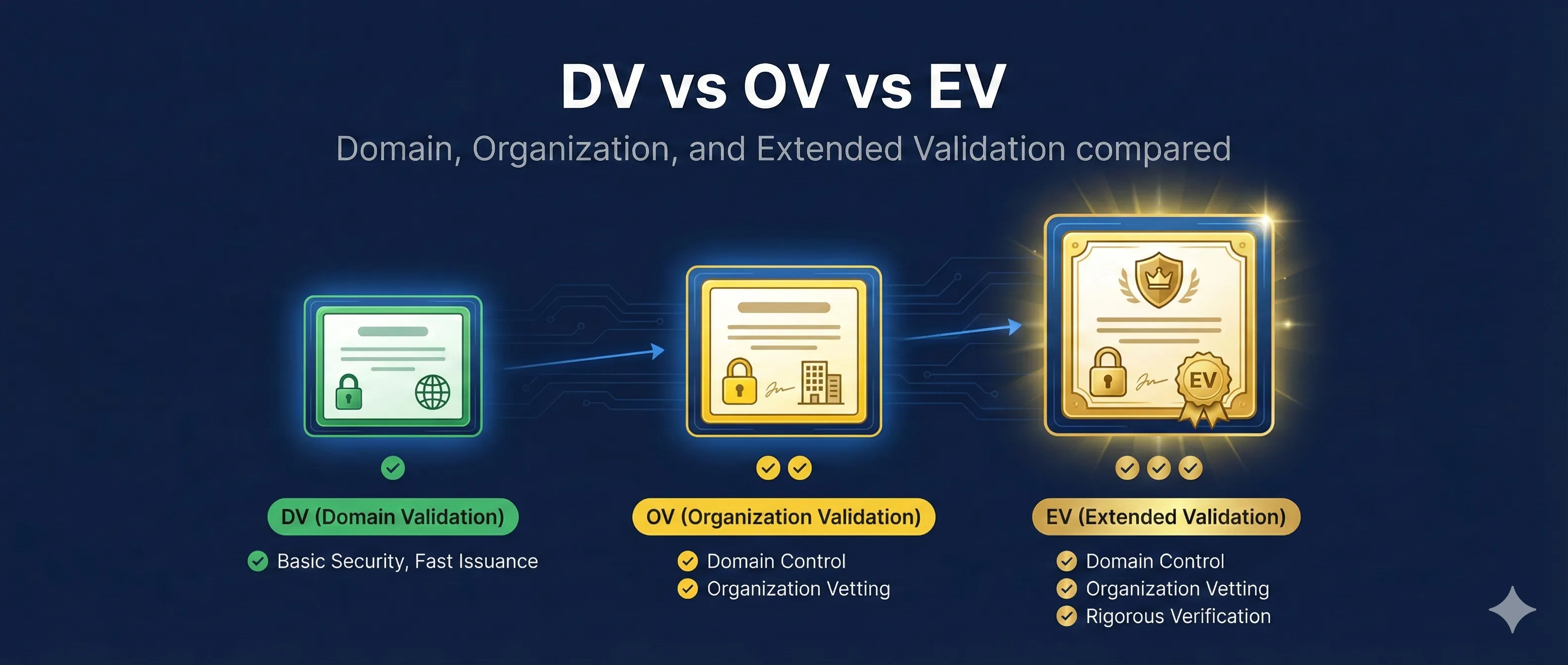
Quick Answer: Which Do I Need?
Personal sites, blogs, internal apps. "I just need HTTPS."
Business websites, SaaS apps. "I want my company name verified."
Banks, e-commerce, compliance. "I need maximum verified identity."
All three provide the same encryption strength. The difference is how much the CA verifies about who you are before issuing the certificate.
Domain Validation (DV) Certificates
What CAs Verify
- 1.You submit a CSR with your domain name
- 2.CA sends a challenge (DNS record, email, or HTTP file)
- 3.You complete the challenge (proving domain control)
- 4.CA issues the certificate - done!
DV Certificate Characteristics
| Time to Issue | Minutes to hours |
| Cost | Free (Let's Encrypt) to ~$50/year |
| What's Verified | Domain control only |
| Certificate Shows | Domain name only (no organization) |
| Browser Display | Padlock only |
Best Use Cases for DV
- Personal websites and blogs
- Development and staging environments
- Internal tools and applications
- Any site where organization identity doesn't matter
Organization Validation (OV) Certificates
OV certificates verify both domain control AND that your organization legally exists. Your company name appears in the certificate (visible when users click the padlock).
What CAs Verify
- 1.All DV verification steps first
- 2.CA checks business registration databases (Dun & Bradstreet, government registries)
- 3.CA verifies organization phone number from public records
- 4.CA calls the organization to verify the certificate request is legitimate
- 5.CA issues certificate with organization name embedded
OV Certificate Characteristics
| Time to Issue | 1-3 business days |
| Cost | $50-200/year |
| What's Verified | Domain + Organization exists |
| Certificate Shows | Domain + Organization name |
| Browser Display | Padlock (org visible in cert details) |
Best Use Cases for OV
- Business websites
- Public-facing APIs
- SaaS applications
- When customers should be able to see your company name
Extended Validation (EV) Certificates
EV certificates are the most thoroughly vetted. CAs verify not just that your organization exists, but its legal standing, physical location, and operational history.
What CAs Verify
- 1.All OV verification steps first
- 2.CA verifies legal existence (articles of incorporation, government records)
- 3.CA verifies physical business address
- 4.CA verifies operational existence (3+ years history or bank reference letter)
- 5.CA verifies requestor has authority (corporate officer verification)
- 6.Face-to-face or video verification may be required
- 7.CA issues certificate with verified legal name
EV Certificate Characteristics
| Time to Issue | 1-2 weeks |
| Cost | $200-500+/year |
| What's Verified | Domain + Organization + Legal identity + Physical address |
| Certificate Shows | Domain + Full verified legal identity |
| Browser Display | Padlock (green bar removed in 2019) |
Best Use Cases for EV
- Banking and financial services
- E-commerce with payment processing
- Healthcare portals
- Government services
- When compliance requires maximum identity verification
Side-by-Side Comparison
| Feature | DV | OV | EV |
|---|---|---|---|
| Domain Verified | ✓ | ✓ | ✓ |
| Organization Verified | ✗ | ✓ | ✓ |
| Legal Identity Verified | ✗ | ✗ | ✓ |
| Physical Address Verified | ✗ | ✗ | ✓ |
| Issuance Time | Minutes | Days | Weeks |
| Price Range | Free-$50 | $50-200 | $200-500+ |
| Encryption Strength | Same | Same | Same |
The Green Bar Story
What Changed in 2019
EV certificates used to show a distinctive green address bar with your company name. Chrome 77 and Firefox 70 removed this UI treatment, making EV certificates look identical to DV/OV in the address bar.
Why Browsers Removed the Green Bar
- •Research showed most users didn't notice or understand the green bar
- •Phishing sites obtained EV certs for misleading company names
- •Limited UI space on mobile devices
- •Simplifying the user mental model
What EV Still Provides
- ✓Verified legal identity embedded in the certificate
- ✓Required by some compliance frameworks (PCI-DSS, HIPAA)
- ✓Audit trail of thorough vetting process
- ✓Certificate Transparency logs show verified organization
How to Choose
Choose DV If:
- • You just need basic HTTPS encryption
- • It's a personal project or internal tool
- • Speed and cost are priorities
- • Organization identity doesn't matter for your use case
Choose OV If:
- • You're a legitimate business with a public website
- • You want customers to see your company name in the cert
- • You need some identity verification for trust
- • EV is overkill but DV isn't enough
Choose EV If:
- • You handle sensitive financial or health data
- • Compliance requirements mandate it
- • Maximum identity verification is important to your customers
- • You're in banking, finance, healthcare, or government
Related Resources
Certificate Anatomy
Understand the structure that differs between DV, OV, and EV certificates.
Domain Validation Methods
Learn HTTP, DNS, and email validation techniques for DV certificates.
Certificate Lifecycle
Manage your DV, OV, or EV certificate from issuance to renewal.
Extended Key Usage
Understand EKU extensions and certificate policy OIDs.
ACME Protocol
Automate DV certificate issuance with Let's Encrypt and ACME.
Frequently Asked Questions
Does EV provide better encryption than DV?
No. All three validation types use the same encryption algorithms and key sizes. The difference is only in identity verification, not security strength.
Is the EV green bar coming back?
Unlikely. All major browsers have moved away from special UI treatment for EV. The industry consensus is that users didn't benefit from it.
Can I get a free OV or EV certificate?
No. The verification process requires human review and costs money. Only DV certificates can be fully automated and free.
Should startups use EV certificates?
Usually not necessary. DV is fine for most startups. Consider OV once you're established, and EV only if you're in a regulated industry.
See the Verification Steps in Action
Our interactive demo shows exactly what CAs check for each validation level.
Open DV vs OV vs EV Demo